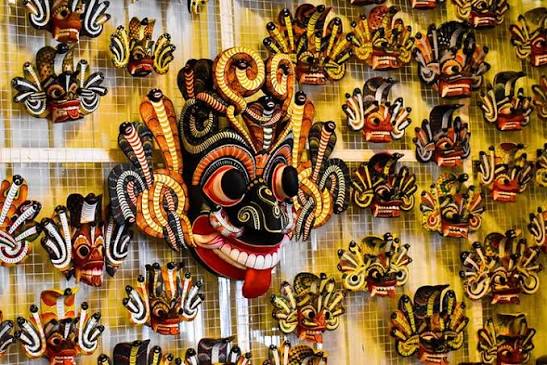
Drive along the southern coast and you will pass shopfronts hung with rows of brightly painted wooden faces: cobras rearing from foreheads, tongues lolling, eyes swollen and bloodshot. Ambalangoda, a coastal town between Bentota and Hikkaduwa, is the recognised heart of Sri Lankan mask carving, and the tradition here is far older and more serious than the souvenir stalls suggest.
Three families of masks
Sri Lankan masks divide into three distinct traditions, each with its own purpose, repertoire and performance style.
Sanni masks: masks for healing
The sanni yakuma is a healing ritual in the low country tradition, performed for a person suffering from illness thought to have a spiritual dimension. There are eighteen sanni demons, each associated with a specific affliction - one for temporary insanity, one for vomiting and bile, one for blindness, one for fevers and shivering, one for stomach ailments, and so on.
Each demon has its own mask, its own colour scheme, its own dance and its own verses. During an all-night ceremony, the dancer summons each in turn, performs its character, and then ritually subdues it. Presiding over the eighteen is Maha Kola Sanni Yaka, an enormous composite mask with the eighteen smaller faces arranged around a central figure, sometimes over a metre and a half tall.
These ceremonies were and in places still are a form of community psychotherapy: the patient sits through the night, the whole village attends, the illness is named, performed and defeated, and there is a great deal of laughter along the way.
Kolam masks: village satire
Kolam is folk theatre, and its masks are comic and social rather than medical. The repertoire includes the king and queen, the village headman, the drummer, the washerwoman, the police officer, the pregnant wife, the soldier and various animals.
The performances are broad, bawdy and pointed. Colonial officials, corrupt petty officers and pompous local grandees all get their turn. Kolam is the tradition that lets a village say out loud, behind a mask, what could not be said to a face.
Raksha masks: the great demons
Raksha masks are the ones tourists photograph most. The Naga Raksha, the cobra demon, has a nest of writhing snakes for hair, bulging eyes and a protruding tongue. There are also fire demons, bird demons and peacock demons. These appear in processions and festivals rather than healing rituals, and are used to ward off evil.
How they are made
The preferred timber is kaduru, the wood of the milkwood tree. It is light, close-grained, resistant to cracking and easy to carve - qualities that matter when a dancer has to wear the thing all night.
The process is unhurried. Timber is smoked and dried for weeks, sometimes months, over a slow fire to season it and drive out moisture and pests. The rough shape is cut, then the features are carved with a set of chisels and gouges, many of them made by the carvers themselves.
Traditional colouring used natural pigments and resins, though modern enamel paints are common now. The convention of colour is meaningful rather than arbitrary: particular demons take particular skin tones, and a knowledgeable viewer can identify a sanni demon at a glance from its palette and features alone.
The carving families
Mask carving in Ambalangoda has passed down through specific families for generations. The best known is the Wijesooriya lineage, associated with the Ariyapala family, whose museum and workshop on the main road is the standard starting point for visitors.
The museum is small but genuinely informative, with the full set of eighteen sanni masks displayed and explained, and a workshop at the back where you can watch carvers at work. There is a second well-regarded museum nearby run by another branch of the same tradition. Both are worth an hour.
Is it still alive?
Honestly, partially. Full overnight thovil ceremonies are much rarer than they were fifty years ago, particularly near cities, as hospital medicine has displaced ritual healing. Kolam performances are now more often staged for festivals and cultural events than spontaneously mounted by villages.
But the tradition has not died. Dance troupes maintain the repertoire, the masks are still used in performance rather than only in display cabinets, and there are working ritual specialists in the south and southwest. Sri Lanka's National Museum and the Department of Cultural Affairs actively document these practices as part of the island's intangible heritage.
Buying a mask
If you want one, buy from the workshops in Ambalangoda rather than a roadside stall. Ask what the mask represents - a good seller will tell you which sanni demon it is and what ailment it governs, and that information is half the pleasure of owning it. Kaduru wood masks are noticeably lighter than the mass-produced alternatives, and hand-carved detail around the eyes and teeth is easy to distinguish from moulded work once you have seen the difference.
Prices range from very cheap decorative pieces to serious performance-grade masks costing a great deal more. Both have their place. Just know which one you are buying.