Sri Lanka celebrates two new years. There is the calendar one on 1 January, which passes with fireworks and not much else. And there is Aluth Avurudu, the Sinhala and Tamil New Year in April, which stops the country completely for several days and is by some distance the most important secular festival on the island.
It is celebrated by Sinhala Buddhists as Aluth Avurudu and by Tamil Hindus as Puthandu, on the same dates, with overlapping customs. For a visitor, it is the single best window into Sri Lankan domestic culture.
Why April?
The date is not arbitrary and it is not fixed by a printed calendar. Avurudu marks the sun's transit from the constellation of Pisces into Aries, which usually falls on 13 or 14 April. The exact moment is calculated by astrologers each year and published nationally, down to the minute.
This matters because the entire festival runs on a schedule of nekath - auspicious times - issued annually. Newspapers print them. Television announces them. Families follow them.
Nonagathe: the neutral period
The most distinctive element of Avurudu is the interval between the old year ending and the new year beginning. Because the transit takes time, there is a gap - traditionally several hours - called the nonagathe or neutral period.
During the nonagathe, all work stops. Cooking stops. Business stops. The prescribed activity is religious observance: families go to the temple, and the hearth stays cold. It is genuinely eerie and rather lovely to be in a Sri Lankan town during those hours. Streets that were frantic an hour earlier go quiet.
Then the auspicious moment for lighting the hearth arrives, and the country switches back on at once. In villages you will hear firecrackers going off simultaneously across the valley.
The sequence of rituals
Each stage has its own appointed time and, often, its own prescribed colour of clothing and direction to face.
- Bathing for the old year - a herbal bath, often with a paste of specific leaves applied to the head, marking the close of the old year.
- Lighting the hearth - the first fire of the new year, at the auspicious minute, facing the prescribed direction.
- Cooking kiribath - milk rice, the ceremonial dish of every Sri Lankan beginning, made with rice cooked in thick coconut milk and cut into diamonds.
- The first meal - eaten together at the appointed time, always beginning with kiribath.
- Ganu Denu - literally "giving and taking", the first financial transaction of the year, performed ceremonially within the family to ensure prosperity.
- Anointing with oil - hisa thel gema, usually performed at the temple or by an elder, with herbal oil applied to the head.
- Leaving for work - even the first departure to one's workplace has an auspicious time and direction.
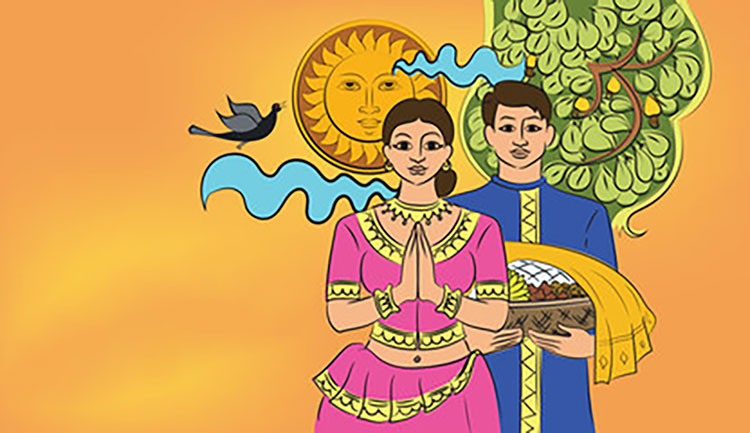
Running through all of it is the custom of visiting elders, offering a sheaf of betel leaves with both hands and receiving a blessing. Neighbours visit each other constantly, and turning up at a Sri Lankan house during Avurudu without eating something is essentially impossible.
The table
Avurudu sweets are a category of their own, and most of them are built from rice flour, coconut treacle and coconut oil:
- Kavum - deep-fried oil cakes with a distinctive peaked top, made from rice flour and treacle.
- Kokis - crisp, flower-shaped fritters made with a hot iron mould dipped in batter. The name and the technique came from the Dutch.
- Aluwa - a diamond-shaped sweet of rice flour and treacle, sometimes with cashew.
- Aggala - roasted rice flour balls with treacle and pepper.
- Mung kavum - a richer version made with green gram flour.
- Kiribath - the milk rice, usually eaten with lunu miris, a fiery onion and chilli sambol.
Plantains, betel and a pot of tea complete the spread, and it is refreshed constantly for several days.
Avurudu games
The festival period brings village sports competitions, and they are enthusiastically silly. Kotta pora is pillow fighting while straddling a horizontal pole. Kana mutti bideema involves being blindfolded, spun around and given a stick to smash a hanging clay pot. There is tug of war, sack racing, the greasy pole climb, and onchili pedeema, singing on decorated swings.
Many villages crown an Avurudu Kumari - a new year princess - in a competition judged on traditional accomplishment and bearing. Raban drumming, played on a large flat drum by a circle of women, provides the soundtrack.
If you are visiting
Be warned: the country genuinely shuts. Shops close for days, public transport becomes overwhelmed in the run-up as everyone travels to their home village, and beach resorts fill with domestic holidaymakers. Book ahead and do not plan long journeys on the 12th or 13th of April.
But if you get invited into a home during Avurudu - and Sri Lankan hospitality being what it is, you well may - accept immediately. Bring something small, eat everything you are offered, and try the kavum. That is the whole festival in one bite: sweet, oily, slightly burnt at the edges, and made by somebody's grandmother to a recipe nobody has ever written down.