Twelve kilometres east of Anuradhapura, a cluster of rocky hills rises from the plain. It is a modest landscape by Sri Lankan standards - no dramatic fortress, no towering cliff. Yet for Sri Lankan Buddhists, Mihintale is the place where everything began. It is often described as the cradle of Buddhism on the island, and on one night each June it becomes the destination of one of Asia's most moving pilgrimages.
The meeting
The story, as told in the ancient chronicle the Mahavamsa, is one of the best-known narratives in Sri Lankan culture. In the 3rd century BCE, King Devanampiya Tissa was hunting deer on the hill of Missaka. A voice called his name. Turning, he found a shaven-headed figure in robes standing before him - Mahinda, a monk and, according to tradition, the son of the great Indian emperor Ashoka, sent to bring the Buddha's teaching to Lanka.
What followed was not a sermon but a test. Mahinda pointed to a mango tree and asked the king a series of questions about it: is this a mango tree? Are there other mango trees? Are there trees other than mango trees? Is there any tree other than the remaining mango trees and the other trees? The riddle was designed to gauge whether the king could reason carefully enough to receive the teaching.
He could. Mahinda preached, the king converted, and Buddhism took root in a kingdom that has remained overwhelmingly Buddhist for more than two thousand three hundred years.
What survives on the hill
Mihintale today is an archaeological complex spread across several summits, connected by a granite stairway of some 1,840 steps. The climb is broad, shaded by frangipani trees, and far gentler than the number suggests.
Along the way and above you will find:
- Kantaka Chetiya - one of the earliest stupas in Sri Lanka, notable for its four exquisitely carved vahalkada, or frontispieces, decorated with dwarves, geese and floral panels.
- The Ambasthala Dagoba - the Mango Tree stupa, built on the spot where tradition places the meeting itself. Beside it stands a statue of Devanampiya Tissa.
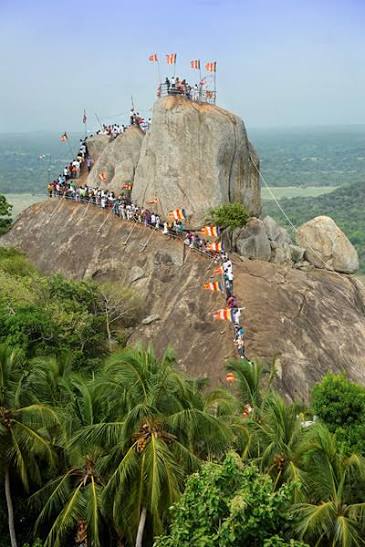
- Aradhana Gala - the Rock of Invitation, a bare granite dome reached by a handrail-assisted scramble. The views over the plain are enormous.
- Maha Seya - the largest stupa on the site, crowning the highest point.
- The Refectory and Alms Hall - with a huge stone rice trough and, remarkably, inscribed stone tablets from the 10th century laying out the rules for administering the monastery.
- The hospital ruins - among the oldest known hospital sites in the world, including a stone medicinal immersion trough carved to fit a reclining human body.
The monastery once housed a large community of monks in cave dwellings cut into the rocks, their drip-ledges still visible above the entrances - a simple, elegant solution for keeping rainwater from running into the shelter.
Poson: the night the hill fills with light
Poson Poya, the full moon of June, commemorates Mahinda's arrival, and it is the single most important date in the Mihintale calendar. Tens of thousands of pilgrims dressed in white ascend the stairway, many of them by torchlight or under strings of coloured lamps.
The atmosphere is different from Sri Lanka's grander festivals. There are no elephants and no processions here. Poson at Mihintale is quieter, more devotional, and for many visitors more affecting - a slow river of white-clad people climbing a hill in the dark, with volunteers handing out free food and drink to anyone who passes. That practice, called dansala, is itself one of the loveliest things about Sri Lankan festival culture.
Why the meeting mattered so much
It is easy to underestimate what happened at Mihintale. The conversion did not simply add a religion to Sri Lanka. It restructured the state.
Kingship became bound up with the protection of the Sangha, the monastic order. Enormous royal resources flowed into monasteries, which in turn became centres of learning, medicine, agriculture and literacy. The Pali canon was preserved and later committed to writing on the island. A distinct written history began, in the form of the chronicles. And the identity that formed around all of this - Sinhala language, Theravada Buddhism, kingship, irrigation - has shaped the island ever since, for better and, at times in modern history, for worse.
Visiting
Go early morning or late afternoon; the granite gets very hot underfoot and shoes must be removed in the sacred zones near the top. Modest dress is required. The climb takes around thirty to forty minutes at a relaxed pace with stops.
Mihintale pairs naturally with Anuradhapura, and many travellers do it as a half-day extension. If you can, save it for the end of the afternoon: the light across the plain from Aradhana Gala as the sun drops is one of the quiet pleasures of the Cultural Triangle, and the crowds have usually gone.