There are older trees on earth. There is no older tree whose planting date, planter and continuous history are recorded in writing. The Jaya Sri Maha Bodhi at Anuradhapura was planted in 288 BCE, and it has been under human care every day since - which makes it, by a wide margin, the oldest living human-planted tree with a documented history anywhere in the world.
Where it came from
The Buddha attained enlightenment beneath a sacred fig - Ficus religiosa - at Bodh Gaya in northern India. When Buddhism reached Sri Lanka through the monk Mahinda, his sister Sanghamitta, a nun, is said to have brought a cutting of the southern branch of that very tree to the island.
The Mahavamsa describes the arrival in unusual detail: the branch carried in a golden vessel, the landing at Jambukola in the north, the procession south to Anuradhapura, and the planting by King Devanampiya Tissa in the Mahamewna Gardens. Eight saplings from the same branch were distributed to other locations across the island, and their descendants still grow at temples nationwide.
There is a poignant footnote. The parent tree at Bodh Gaya was destroyed and replanted more than once over the centuries. When it was restored in the 19th century, a sapling from the Anuradhapura tree was used. The child returned home to become the parent.
What it looks like now
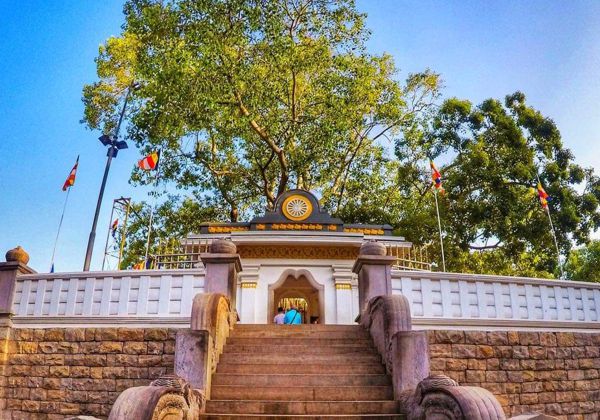
Visitors sometimes arrive expecting a single towering trunk and are briefly confused. The Bodhi tree sits on a series of raised terraces, and the ancient main trunk is comparatively modest, propped and supported, surrounded by younger trees grown from its own aerial roots and offshoots.
Gold-plated railings enclose the innermost terrace. Prayer flags in yellow, white and orange are tied along the surrounding walls. On any given day you will find pilgrims in white sitting on the sand, quietly chanting, and a steady stream of people pouring water at the base and setting lotus flowers on the offering tables.
An outer wall was built in the 18th century to keep wild elephants out. Look closely at the surrounding masonry and you will find inscriptions and carvings spanning many centuries of patronage.
Bodhi Puja: worshipping a tree
The practice of venerating the Bodhi tree, known as Bodhi Puja, is one of the most visible devotional customs in Sri Lanka and can be seen at almost every temple on the island, not only at Anuradhapura.
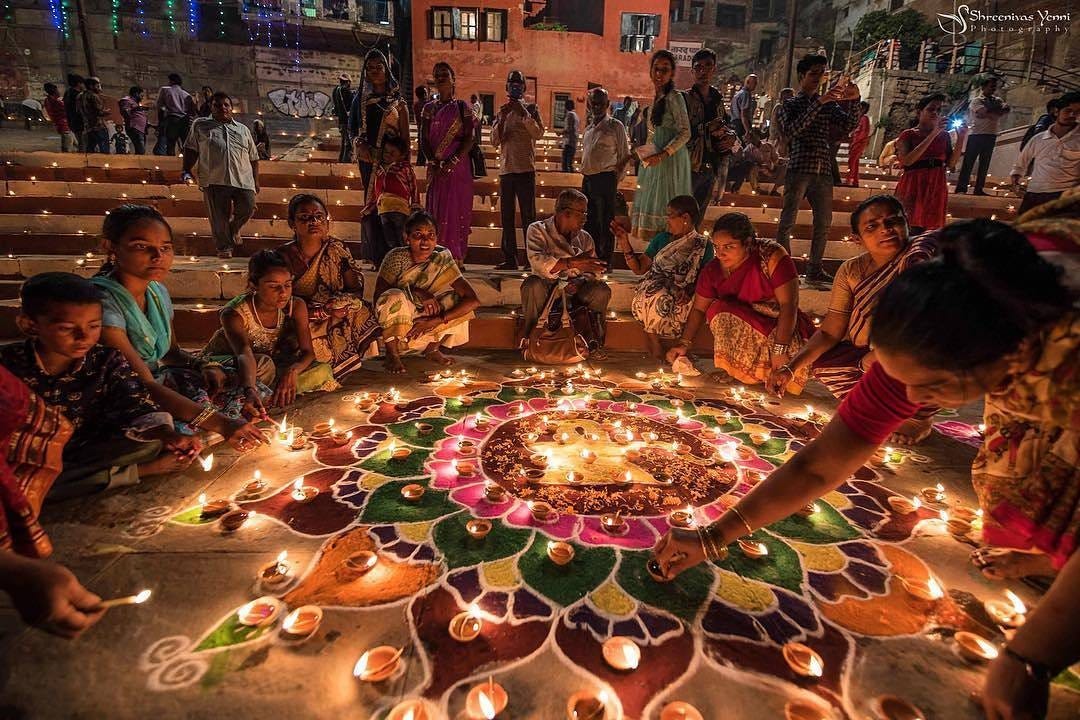
Devotees pour water at the roots, light oil lamps, offer flowers and hang small flags. Chanting often continues for hours. It is important to understand what is and is not happening here: the tree is not a god. In Buddhist understanding it is a reminder - a living object associated with the moment of the Buddha's awakening, and therefore a focus for reflection, gratitude and merit-making.
Many Sri Lankans perform Bodhi Puja at moments of difficulty - before examinations, during illness, ahead of a journey. The atmosphere is calm rather than dramatic. If you sit quietly at the edge of the terrace in the early evening, you will hear the chanting rise and fall in Pali, a language nearly as old as the tree itself.
Guarded for twenty-three centuries
The continuity of care is the astonishing part. Kings appointed guardians and endowed lands for the tree's upkeep. Monastic communities maintained daily rituals. When capitals moved and Anuradhapura was abandoned to the forest, local devotion kept the site alive.
Modern care is a serious scientific undertaking. Botanists monitor the tree's health, soil conditions are managed, and the surrounding structures are engineered to reduce root compaction from the enormous numbers of visitors. Threats over the years have included drought, pests and, in one dark episode of the civil conflict, an attack at the site in 1985.
How to visit respectfully
The Jaya Sri Maha Bodhi is among the holiest places in the Buddhist world, and visitors are genuinely welcome. A few points of courtesy make a large difference:
- Wear white or light, modest clothing covering shoulders and knees. Sarongs are available near the entrance.
- Remove shoes and hats before entering the sacred terraces.
- Never turn your back to the tree or a Buddha image for a photograph - posing with your back to it is considered deeply disrespectful.
- Keep your voice down. Move around sacred objects clockwise.
- Do not step on or over anyone seated on the ground in prayer.
Why it moves people
Plenty of visitors arrive uninterested in Buddhism and leave slightly shaken. Part of it is the arithmetic. This tree was planted when Rome was still fighting Carthage. It was already ancient when the Anglo-Saxons arrived in Britain. Empires have risen and disappeared while people walked to this spot with a jug of water and a handful of flowers, and did the same small thing.
Continuity on that scale is rare, and standing in front of it is a genuinely strange and beautiful experience, whatever you believe.