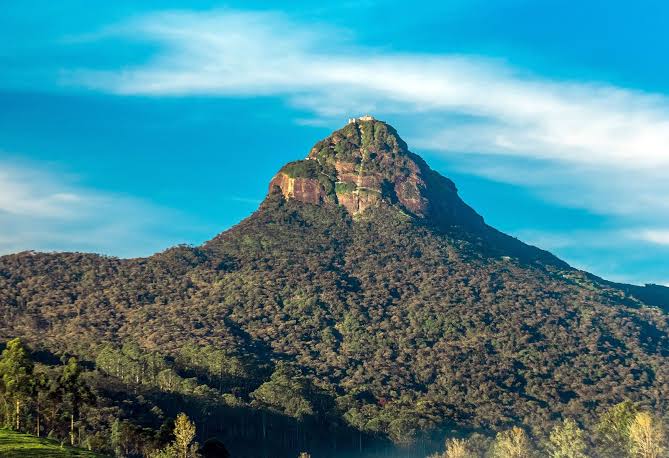
Most sacred mountains belong to somebody. Adam's Peak belongs to everyone, which is precisely what makes it extraordinary. Rising to 2,243 metres in the central highlands, this conical peak is a place of pilgrimage for four faiths at once, and has been for well over a thousand years.
Four names, one footprint
Near the summit, sheltered by a small shrine, is a hollow in the rock roughly 1.8 metres long, shaped like a giant footprint. Its identity depends on who you ask, and all four answers coexist with remarkably little friction:
- Buddhists call the mountain Sri Pada, the sacred footprint, left by the Buddha on the third of his legendary visits to the island.
- Hindus know it as Shivanolipatha Malai and attribute the print to Lord Shiva.
- Muslims and many Christians identify it as the footprint of Adam, who is said to have stood here on one foot in penance after being expelled from Eden - hence the English name.
- Some Christian traditions in the island associate it instead with Saint Thomas the Apostle.
Sinhala speakers often simply call it Samanala Kanda, the butterfly mountain, after the butterflies that migrate towards the peak, and after the deity Saman, one of the island's guardian gods, whose domain covers this region.
The climb
The pilgrimage season runs roughly from the December full moon (Unduvap Poya) to the Vesak full moon in May. Outside these months the trail is open but largely unlit, the tea stalls are shuttered, and the weather is unreliable.
The classic route starts at Dalhousie (Nallathanniya) and involves around 5,500 steps, ascending some 1,000 metres over about seven kilometres. Most pilgrims begin between two and three in the morning to reach the summit before dawn. Longer, harder routes exist from Ratnapura and Kuruwita for those who want the older pilgrim experience.
During the season the whole staircase is illuminated, and from a distance the mountain appears strung with a thread of light winding up into the dark. Tea shacks along the way sell plain tea and roti at three in the morning. There are shrines, bells, and a general atmosphere of good-humoured collective suffering.
Traditions along the way
First-time pilgrims, called kodukaru, traditionally wear a white headband and are teased affectionately by others on the path. Near the beginning of the climb, at the Indikatupana, tradition holds the Buddha mended his robe, and pilgrims pause there. Many ring the bell at the summit once for each completed pilgrimage - you will hear veterans ringing it a dozen times or more.
Elders, children and people who look thoroughly unprepared all make it up. Pace is more important than fitness. The steps are steep and irregular in the final stretch, and altitude plus cold air at the top surprises people who have spent the previous week on a beach.
The shadow
The reason everyone climbs through the night is what happens at sunrise. As the sun comes up behind the peak, the mountain casts a perfect triangular shadow onto the clouds and hills to the west. It is a startlingly sharp, geometrically precise cone, and it appears to hover rather than lie flat, then retracts towards the mountain as the sun rises.
The phenomenon lasts roughly twenty minutes. On a clear morning it is among the finest natural spectacles in Asia, and the collective reaction of several thousand cold, exhausted people watching it together is part of the experience.
A long history of visitors
Foreign travellers have written about this mountain for centuries. Ibn Battuta climbed it in the 14th century and left a detailed account of the chains fixed along the steepest section to help pilgrims haul themselves up - some of which are traditionally attributed to King Vijayabahu I. Marco Polo mentioned it. Chinese, Arab and Persian sources all record its fame.
Sri Lankan kings maintained the route, endowed rest houses and granted lands for its upkeep. The path itself is a heritage artefact.
Practical advice
- Bring warm layers. The summit can drop close to freezing with wind chill, and you will be standing still, sweating, waiting for the sun.
- Carry water but do not overload; there are stalls throughout during season.
- Weekends and poya days are extremely crowded, sometimes with queues on the final staircase. Weekdays are far more pleasant.
- Allow three to five hours up, and expect the descent to punish your knees more than the ascent punished your lungs.
- Remove shoes at the summit shrine area and dress modestly.
What it represents
Sri Lanka's modern history has included painful religious and ethnic division. Adam's Peak stands as a quiet counterargument. On the same staircase, in the same darkness, Buddhist families, Tamil Hindu pilgrims and Muslim visitors climb together towards a single rock that each understands differently and all treat as holy. Very few places on earth manage that. It is worth the 5,500 steps to see it.