For roughly four centuries after the Buddha's death, his teachings — the Tipitaka, the three baskets of doctrine, monastic rule and philosophical analysis — existed entirely in oral form, memorised and transmitted by trained monks whose job it was to hold the canon in their heads. In the 1st century BCE, at a cave monastery called Aluvihare near Matale in central Sri Lanka, that changed.
A famine and a series of conflicts had dramatically reduced the number of monks capable of maintaining oral transmission without loss. A council of monks made the decision to commit the entire Pali canon to writing, inscribed on prepared ola palm leaves in a painstaking process that reportedly took years to complete. It was one of the most consequential literary events in the history of religion: before Aluvihare, Theravada Buddhism existed in human memory; after it, it existed in text.
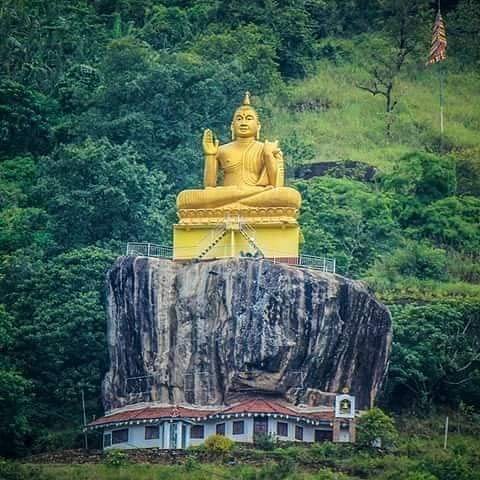
The site today is a working temple, its cave shrines built into a dramatic rock outcrop above a small river, connected by a stairway of steps that winds between boulders. The caves contain painted murals and Buddha images, some of them quite old, in the dimly lit chambers where monks once bent over palm leaves by whatever light was available.
There is also a small room demonstrating traditional ola leaf manuscript preparation — the laborious process of cleaning, drying and treating the leaves, scribing with a stylus, then rubbing soot or charcoal into the incisions to make the text visible. The Sri Lankan National Archives and various temple libraries still hold collections of these manuscripts, including some of extraordinary age and scholarly value.
Aluvihare receives relatively few visitors by comparison with the major archaeological sites, which makes it one of the more contemplative places in the Cultural Triangle region. A morning there, in the quiet between the caves and the river below, is a good place to sit with the thought that the words you might have read in a printed Buddhist text somewhere trace their unbroken line back to this exact spot.