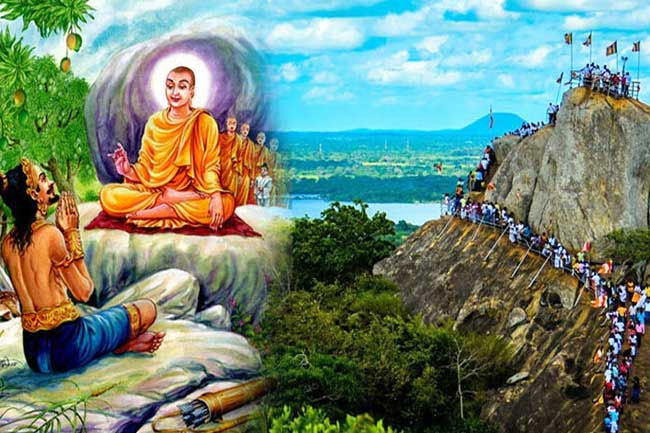
If Vesak is joyful, Poson is contemplative. The June full moon commemorates Mahinda's arrival at Mihintale and his conversion of King Devanampiya Tissa — the moment Buddhism took root on the island — and the way Sri Lankans mark it is by doing exactly what the story implies: climbing a hill in the dark, in white clothes, carrying lamps.
On Poson Poya night, Mihintale's 1,840 granite steps fill with an almost continuous river of pilgrims moving upward in both silence and community. The staircase is strung with lights. Volunteers positioned every hundred metres or so hand out water, tea, biscuits and limes to anyone who passes without asking for anything in return — the dansala tradition in its purest form. By the time you reach the upper terraces and look back down the illuminated staircase at the line of people still coming up from below, the cumulative effect of a thousand small acts of generosity is palpable.
Mihintale is also fully illuminated for the occasion — the stupas lit, the caves marked with oil lamps, the Aradhana Gala rock crowded with people sitting quietly looking out over a vast, dark plain. It is among the most genuinely moving festivals in Sri Lanka, primarily because it makes no demands on the visitor: you are simply invited to walk up, eat what you are given, and sit for a while.
Nearby Anuradhapura holds its own Poson celebrations simultaneously, with illuminated streets and temporary pavilions. Many pilgrims combine both in a single overnight visit. If your Sri Lanka trip falls in June, rearranging your plans to be at Mihintale on Poson night is one of the best decisions you can make.