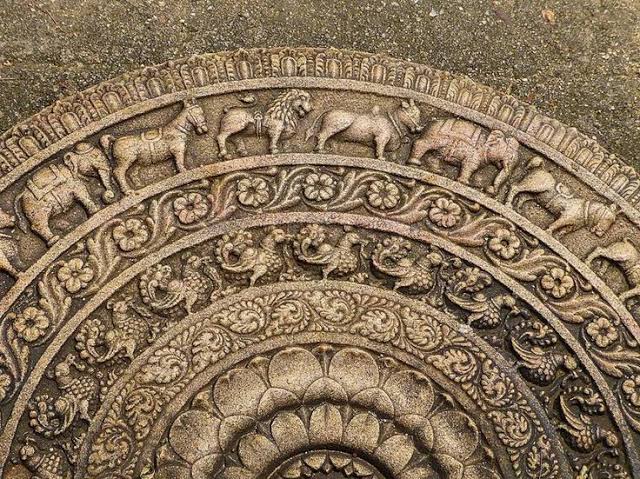
At the base of the steps leading into almost every ancient Buddhist site in Sri Lanka lies a semicircular stone slab carved with concentric bands of flames, animals, vines and birds, spiralling towards a lotus at the centre. It is called the sandakada pahana, usually translated as moonstone, and it is one of the most distinctive contributions Sri Lanka has made to world architecture.
Most visitors walk straight over it. It rewards stopping.
The name and the form
The Sinhala name derives from the half-moon shape - ada sanda. The Mahavamsa mentions such stones, and the Pali commentary known as the Samantapasadika refers to a half-moon shaped carving called a patika.
Early examples were plain, and some were square or rectangular rather than semicircular - the moonstone at Mirisawetiya in Anuradhapura is a rectangular survivor from an early phase. The semicircular decorated form developed later in the Anuradhapura period and then evolved through the Polonnaruwa, Gampola and Kandyan periods.
The moonstone belongs to a trio of entrance sculptures that appear together: the moonstone itself at the foot of the steps, the muragala or guardstones flanking them, and the korawakgala or wing-stone balustrades running up the sides.
Reading a classic Anuradhapura moonstone
The mature Anuradhapura moonstone - the finest example is at the Mahasen Palace site at Abhayagiri, often called simply "the Queen's Pavilion moonstone" - has a defined sequence of bands, working from the outer edge inwards:
- A ring of flames. The fires of worldly desire, greed and delusion - the burning world you stand in before you approach.
- A procession of four animals - elephant, horse, lion and bull - walking in file. These are widely interpreted as the four great stages of life: birth, decay, disease and death. Some scholars read them as the four cardinal directions or as symbols of strength, power, pride and endurance.
- A scrolling vine (liya vela). Craving and attachment, the tangling growth that binds beings to the cycle of rebirth.
- A row of geese or swans (hansa), often carrying a sprig in the beak. The hansa is a symbol of discrimination - in Indian tradition it can separate milk from water - and therefore of the ability to distinguish good from bad.
- A half lotus at the centre. Purity, awakening, nirvana.
Read outward to inward, the moonstone traces the entire Buddhist path: from the burning world, through the inevitability of suffering, through craving, through the development of discernment, to enlightenment. You cross it as you step from the ordinary world into sacred ground. The philosophy is not written down. You walk it.
How the design changed
The Polonnaruwa moonstones look different, and the reasons are interesting. The bull was removed from the animal procession - most explanations point to the growing influence of Hindu practice, in which the bull is sacred to Shiva and therefore inappropriate to tread on. The lion also disappears in many examples.
Polonnaruwa moonstones tend to be more elaborate and more decorative, with richer floral work. The Vatadage moonstone in the Quadrangle is often held up as the most beautiful of all, and it is genuinely difficult to argue with that once you see it.
By the Kandyan period the form had simplified considerably, and moonstones became flatter and more stylised, sometimes with just a lotus and a border.
The guardstones beside it
The muragala or guardstone deserves equal attention. Originally these were plain slabs whose job was structural - wedging the heavy balustrades in place and preventing them sliding forward. Over time they became sculpture.
The development ran roughly in three stages. First came the incised punkalasa, a pot of abundance overflowing with foliage - the local equivalent of a cornucopia, symbolising prosperity. Then came dwarf figures and nagas, or cobra deities. Finally came the mature form: a standing guardian, usually identified as a nagaraja or cobra king, holding a pot of plenty and a flowering branch, with a multi-headed cobra hood arching behind him and a dwarf attendant at his feet.
The pair at the Ratnaprasada at Abhayagiri are considered the masterpieces of the type.
Where to see the finest examples
- Abhayagiri, Anuradhapura - the celebrated moonstone at the Mahasen Palace site, and the Ratnaprasada guardstones.
- Vatadage, Polonnaruwa - the most refined of the later period.
- Mirisawetiya, Anuradhapura - an early rectangular example.
- Colombo National Museum - for close examination without the sun overhead.
A small courtesy
At many sites you will notice that Sri Lankan visitors step over the moonstone rather than on it, and that barriers or walkways have been installed at the most important examples. Two thousand years of feet wear granite down faster than you would think. Follow the local lead, take the detour, and give yourself a moment to look at what you are walking around. It is one of the most quietly sophisticated pieces of design in Asia.