Few stories are told as often in Sri Lanka as this one. A young prince from the southern kingdom of Ruhuna rides north on a war elephant to challenge the aged ruler of Anuradhapura. They meet, alone, in ritual combat. One falls. The victor then does something almost nobody expects, and it is that final act, more than the battle itself, that has kept the story alive for over two thousand years.
Two kingdoms, one island
By the 2nd century BCE, Sri Lanka was effectively divided. The southern region, Ruhuna, remained under Sinhalese control, ruled by King Kavantissa, while the north, centred on Anuradhapura, was governed by Elara, a Tamil king from South India who had seized power some decades earlier. The Mahavamsa, the great chronicle compiled by Buddhist monks, gives an unusually generous portrait of Elara for an "enemy" king - it dedicates notable passages to describe the just and fair rule of King Elara, illustrating his commitment to justice, depicting him as a ruler who installed a bell by his bedside with a rope extending to the public for anyone seeking his judgment.
When Kavantissa died, his son Dutugemunu - Dutugamunu the Great in the chronicles - had the throne and the ambition to reunify the island under Sinhalese Buddhist rule.
The long campaign
The march north was not a single battle but a sustained campaign. Dutugemunu defeated a large number of Tamil rulers, as many as 32 according to the Mahavamsa, before reaching Elara's territory. The siege of the fortress at Vijithapura was especially hard fought: the defending Tamil troops are said to have used red-hot iron and molten pitch to panic Dutugemunu's elephants over a siege that lasted four months.
Throughout the campaign, Dutugemunu rode his elephant Kandula, and was accompanied by ten legendary warriors whose individual feats of strength are still recited as folk tales across the island today.
The duel at the gate
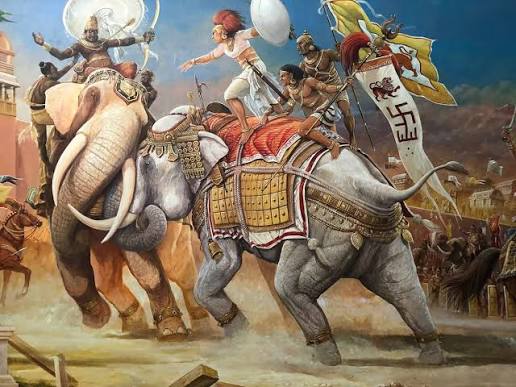
The armies finally met at the eastern gate of Anuradhapura. King Elara, now elderly after 44 years of rule, rode out on his own war elephant, Mahapabbata, to settle the matter in single combat rather than mass slaughter. Dutugemunu, riding Kandula, finally confronted the aged usurped king Elara, on his own elephant Mahapabbata, and slew him with a spear. Dutugemunu had declared that none shall kill Elara but himself, insisting on settling the matter personally rather than delegating it.
What Dutugemunu did next
This is the part most often retold. Rather than desecrating his rival's memory, Dutugemunu built a monument on the spot where Elara fell and decreed - according to tradition maintained for centuries afterward - that anyone passing the site, of any rank, should dismount and pay respect. Elara's memorial reportedly stood and was honoured by Sinhalese rulers for many generations afterward, an almost unheard-of gesture toward a defeated foreign king in the ancient world.
Later in life, the chronicles describe Dutugemunu as troubled by the scale of bloodshed his unification had required, seeking reassurance from Buddhist monks that his cause - protecting the religion - justified the cost. Whether or not this reflects the historical king's actual state of mind, it reflects something the storytellers clearly wanted remembered: that even a celebrated victory carried a moral weight.
How historians read the story today
Modern historians debate how much of the Dutugamunu-Elara story is historical fact versus legend embellished over centuries. The Mahavamsa, written roughly six hundred years after the events, may have dramatised some elements, though most agree the broad outline - a Sinhalese prince from Ruhuna defeating a Tamil ruler of Anuradhapura around this period - reflects real events.
It's worth being direct about why this history is handled carefully today. Scholars note that when the Mahavamsa was compiled, tensions between Sinhalese and Tamil communities had already crystallised, and the chronicle's monastic author was writing with an eye toward defending Sinhala Buddhist sovereignty against contemporary threats - meaning the ancient text itself was already shaping a political narrative, not simply reporting one. In modern Sri Lanka, where Sinhala-Tamil relations carry the weight of a long and difficult 20th-century conflict, this 2,000-year-old story is sometimes invoked in present-day political rhetoric on various sides. Historians increasingly stress the story's own most celebrated detail instead: an act of respect across a battle line, at the very moment when respect would have been easiest to abandon.
Seeing the story's landmarks today
Anuradhapura's eastern approaches are the setting for the duel in tradition, though the exact site is not precisely marked for visitors in the way other monuments are. What survives more visibly are Dutugemunu's building works after his victory: the Ruwanwelisaya stupa and the Lovamahapaya, the nine-storey "Brazen Palace" he built for the monastic community, whose forest of stone pillar stumps still stands near the Sri Maha Bodhi.
The story is worth knowing before you walk among those pillars - not as settled fact, but as one of the oldest and most carefully remembered narratives on the island, still capable of teaching something about how victors choose to treat the defeated.