Before recorded history, before the Sinhalese and Tamil kingdoms that dominate Sri Lanka's historical narrative, there were already people living in the island's forests. The Vedda - the name means "hunter" in Sinhala - are widely regarded as descendants of Sri Lanka's original inhabitants, and their way of life, though now dramatically transformed, represents one of the oldest continuous human traditions in South Asia.
An ancient presence
Genetic and archaeological research suggests Vedda ancestry connects to some of the earliest human populations on the island, likely predating the arrival of Indo-Aryan and Dravidian-speaking settlers whose descendants became the Sinhalese and Tamil populations that now form the overwhelming majority of Sri Lanka's people. The chronicles themselves acknowledge this: the Mahavamsa's legendary account of the founding of the Sinhalese people describes the arrival of Prince Vijaya and his followers encountering an indigenous population already living on the island, a detail generally read as a folk memory of the Vedda or a related pre-existing community.
Traditional life
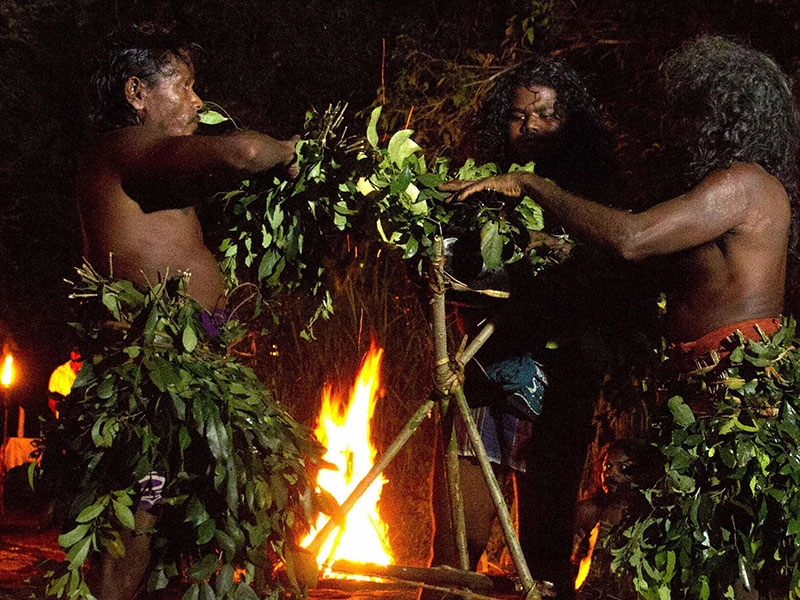
Historically, the Vedda lived as hunter-gatherers in the island's dry-zone forests, particularly in the areas around Dambana in the east-central region, supplementing hunting and gathering with small-scale cultivation over time. Their traditional knowledge of forest ecology, medicinal plants, tracking and honey-gathering represents an intricate body of practical knowledge developed over an extraordinarily long period of continuous engagement with a specific landscape.
Vedda spiritual practice traditionally centred on ancestor veneration rather than the Buddhist or Hindu frameworks that came to dominate the rest of the island, with rituals invoking the spirits of the deceased for guidance, protection and success in hunting. Their language, Vedda, is considered endangered, having absorbed substantial influence from Sinhala over centuries of contact, though efforts to document and preserve it continue among linguists and within Vedda communities themselves.
Pressure and change
Vedda communities have faced sustained pressure for well over a century, driven by deforestation, the expansion of agricultural land, and major infrastructure projects, including large 20th-century irrigation and hydroelectric schemes that altered or restricted access to traditional forest lands. Government resettlement policies, sometimes well-intentioned and sometimes not, have pushed many Vedda families toward settled agricultural life and away from the forest-based practices at the core of their traditional identity.
The population identifying primarily as Vedda today is small, and estimates vary considerably depending on how identity is defined, since many people of partial Vedda ancestry have been absorbed into surrounding Sinhalese or Tamil communities over generations. Communities around Dambana have worked actively, with support from cultural preservation organisations, to maintain and demonstrate traditional practices, including for visitors, though this raises legitimate questions about the line between cultural preservation and performance for tourism that Vedda leaders themselves have engaged with directly.
A living community, not a museum piece
It is worth being clear-eyed about how the Vedda are sometimes presented to outsiders - occasionally in ways that flatten a genuinely complex, adapting contemporary community into a static image of an unchanged ancient past. Vedda communities today live with mobile phones, engage with the modern Sri Lankan economy and education system, and make active choices about which traditions to maintain, adapt or set aside, exactly as any community does.
Visitors who travel to Dambana with a genuine interest in learning, through a responsible operator, and treating the community as contemporary people with a long and specific history rather than as a tourist spectacle, can gain real insight into forest knowledge, traditional practices and a perspective on Sri Lankan history that predates every other narrative on the island. It is, in the most literal sense, the deepest layer of the island's human story.