Sri Lanka's path to independence looks different from many other former colonies. There was no prolonged armed insurgency against British rule comparable to independence struggles elsewhere in Asia and Africa during the same era. Instead, Ceylon - as the island was still officially known - achieved independence in 1948 through a process of constitutional negotiation, gradual devolution of self-government, and political manoeuvring by a relatively small, elite group of local leaders working within the colonial system rather than against it by force.
A century of incremental change
British rule over the whole island dated formally from 1815, following the fall of the Kandyan Kingdom, and Ceylon was administered as a Crown Colony throughout the 19th and early 20th centuries. Colonial rule brought the plantation economy - first coffee, then tea and rubber - along with new infrastructure, a Western-style education system for a portion of the population, and administrative institutions modelled on British practice.
Political change came gradually. Limited representative institutions were introduced from the mid-19th century onward, expanding step by step over decades: legislative councils with a small number of elected or nominated local members, followed by broader constitutional reforms in the early 20th century that increased local representation, and eventually universal adult suffrage introduced in 1931 - notably ahead of many other British colonies, and indeed ahead of full universal suffrage in Britain itself in its final form.
The State Council era
The 1931 constitutional reforms, known as the Donoughmore Constitution, created a State Council with substantial local control over domestic affairs, giving a generation of Ceylonese political leaders real administrative experience well before formal independence arrived. Figures who would go on to lead the independent nation, including D. S. Senanayake, built their political careers and networks during this period, developing the negotiating relationships with British officials that would matter enormously in the final push toward full sovereignty.
Negotiation over confrontation
Compared to India's parallel independence movement - marked by mass civil disobedience campaigns, imprisonment of leaders and significant political violence around partition - Ceylon's path was markedly quieter. D. S. Senanayake and his contemporaries generally pursued a strategy of demonstrating administrative competence and negotiating incrementally expanded self-government, rather than organising mass protest movements against colonial rule.
This approach reflected both a pragmatic assessment of what was achievable and the particular composition of the island's early 20th-century political leadership, drawn substantially from an English-educated professional and landowning elite comfortable working within existing institutional structures.
4 February 1948
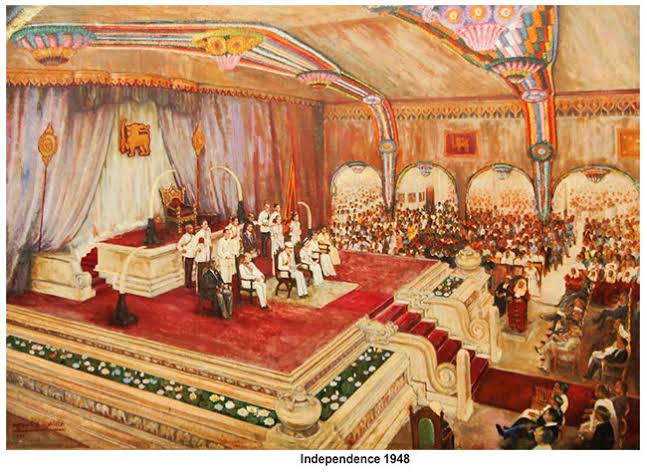
Ceylon formally achieved independence on 4 February 1948, becoming a self-governing dominion within the British Commonwealth, with D. S. Senanayake as its first Prime Minister. The transition retained the British monarch as head of state for the time being, a status that would only change decades later when the country became a republic in 1972 and adopted the name Sri Lanka.
The handover was peaceful, orderly and largely uncontested internationally - a contrast frequently noted by historians comparing decolonisation processes across South Asia.
The unfinished business
Independence achieved through elite negotiation rather than mass mobilisation left certain questions unresolved that would resurface, sometimes violently, in the decades that followed. Language policy, the political status and citizenship rights of different ethnic and religious communities, and the distribution of power between the Sinhalese majority and Tamil, Muslim and other minority communities had not been forced into open confrontation and resolution during the independence struggle itself, in the way such issues sometimes are when a broader mass movement demands their inclusion.
Sri Lanka's subsequent history, including the difficult decades of civil conflict in the later 20th century, is in part a story of those unresolved 1948-era questions eventually surfacing anyway. Understanding the peaceful, negotiated character of Ceylon's independence is therefore useful not only as a historical fact in its own right, but as context for the more troubled chapters of the nation's history that followed it.
Marking the day
4 February is celebrated across Sri Lanka today as Independence Day, with a national ceremony typically held in Colombo featuring military parades and cultural performances. It remains one of the key dates in the modern Sri Lankan calendar, a moment for reflecting on both how independence was won and on the country's ongoing effort to build a shared national identity from its genuinely diverse population.