The name Ratnapura means, quite literally, City of Gems, and it has earned the title honestly. This city in Sri Lanka's southwest sits atop some of the richest gem-bearing gravel deposits in the world, and people have been digging sapphires, rubies and a long list of other precious and semi-precious stones out of the ground here for well over two thousand years.
An ancient reputation
Sri Lanka's gem wealth was known far beyond its shores in antiquity. Classical and medieval writers, from Greek and Roman geographers to Arab and Persian traders and later medieval European travellers including Marco Polo, all made mention of the island's extraordinary supply of precious stones, often describing sapphires and rubies of a size and quality rarely found elsewhere. Some accounts, likely embellished in the retelling across centuries of trade, describe gems of legendary proportions coming from the island's kings.
The reputation was not exaggerated by much. Sri Lanka has produced some of the largest and most celebrated blue sapphires in the world, and gems mined here have found their way into royal treasuries and crown jewels across Asia and Europe for centuries.
Why the gems are here
The geology responsible for this wealth lies in ancient metamorphic rock formations found in the southwestern region around Ratnapura, Elahera and Balangoda. Over vast stretches of geological time, weathering and erosion released precious minerals from the parent rock, which then washed downstream and settled into gravel beds along rivers and in ancient alluvial deposits - the gem-bearing layer locally called illam.
This is why gem mining in Sri Lanka has traditionally been alluvial rather than the deep hard-rock mining associated with some other gem-producing regions: miners dig pits down to the gravel layer, sometimes ten or more metres deep, then wash and sieve the material to separate out the stones.
What comes out of the ground
Sri Lanka produces an unusually wide range of coloured gemstones, including:
- Blue sapphires - the island's signature stone, prized for a distinctive cornflower-blue colour.
- Padparadscha sapphires - an extremely rare pinkish-orange variety essentially unique to Sri Lanka, named from the Sinhala word for lotus blossom.
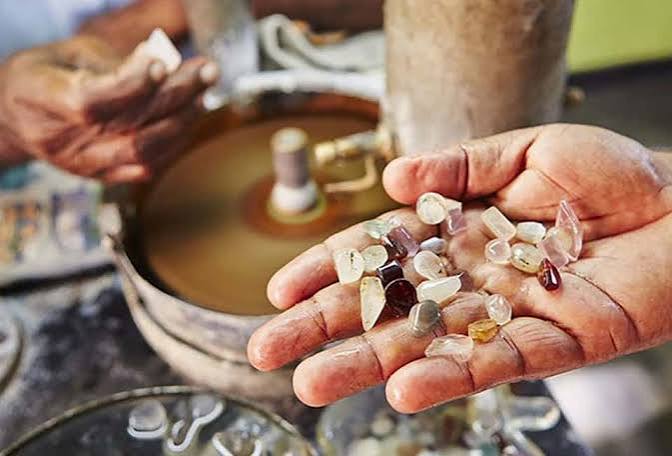
- Rubies, garnets, spinels, topaz, tourmaline, moonstone, alexandrite and cat's eye chrysoberyl, among many others.
The sheer variety of gem species found within a relatively small geological region is unusual internationally and part of why Ratnapura remains a serious centre of the global gem trade rather than a niche curiosity.
How mining actually works
Much of Sri Lanka's gem mining remains small-scale and traditional, often family-run pits rather than industrial operations. Miners dig narrow shafts by hand down to the gem-bearing gravel, then haul baskets of illam up to the surface, where it is washed in woven baskets in nearby streams and sieved by hand to sort stones from gravel - a method that has changed relatively little in centuries, aside from the addition of pumps to manage groundwater in deeper pits.
Once uncovered, rough stones move through a chain of local traders, cutters and polishers before reaching the gem markets and jewellery workshops that give Ratnapura its bustling commercial character.
Visiting
Ratnapura offers gem mine visits where travellers can watch the excavation and washing process firsthand, along with a small gemmological museum explaining the geology and history of the trade. The town's gem market is a genuine working marketplace rather than a tourist recreation, and buying seriously requires expertise - a guide or gemmologist's advice is worth having if you intend to purchase anything of real value, as with any gem market anywhere in the world.
Even without buying anything, watching a family-run pit at work - the descent, the muddy baskets, the practiced hands sorting gravel in a stream - offers a direct, tactile connection to a trade that has quietly enriched this corner of Sri Lanka since before the Roman Empire took any interest in the island at all.