Sri Lanka's tea-covered hill country looks so permanent, so much a part of the landscape's identity, that it is easy to forget the whole industry is barely 150 years old and was born directly out of an agricultural disaster.
The coffee years
Through the middle of the 19th century, British colonial Ceylon was a coffee island. Plantations spread across the central highlands from the 1830s onward, and by the 1860s coffee was the backbone of the colonial economy, exported in vast quantities to Britain and beyond. Fortunes were made. Estates multiplied across land cleared from forest at a punishing pace.
The blight
Then, beginning in the early 1870s, a fungal pathogen called Hemileia vastatrix - coffee leaf rust - swept through the plantations. It attacked the leaves, crippling photosynthesis and yield, and colonial planters had no effective treatment for it. Over roughly fifteen years, the disease devastated Ceylon's coffee industry almost entirely. Estates that had been immensely profitable became worthless. Many British planters lost everything and left the island.
It is one of the great counterfactuals of colonial economic history: had the blight not struck, Sri Lanka might well have remained a coffee-producing island, and the tea industry that so defines it today might never have taken the same shape.
James Taylor's experiment
A Scottish planter named James Taylor had arrived in Ceylon in 1852 and managed the Loolecondera estate near Kandy. Well before the blight became catastrophic, Taylor had begun experimenting with a small planting of tea on part of the estate, aware that the plant grown in China and increasingly in British-controlled Assam might suit the island's climate.
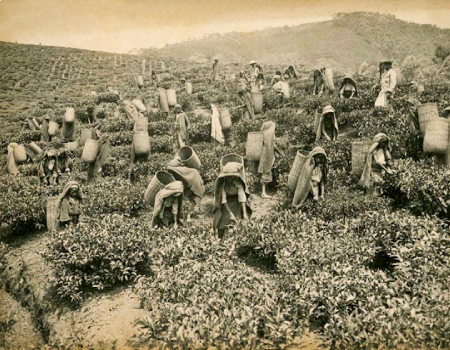
In 1867, Taylor cleared around twenty acres for tea cultivation and began refining processing methods on-site, essentially building his own rudimentary factory equipment. As the coffee blight worsened through the 1870s, planters increasingly desperate for an alternative crop turned to Taylor's experiment for guidance, and tea cultivation expanded rapidly across the hill country in the years that followed.
Thomas Lipton and the world market
The industry that emerged needed distribution and marketing on a global scale, and that role fell to Sir Thomas Lipton, a Scottish grocer who purchased several Ceylon estates in the 1890s and pursued an aggressive strategy of direct-to-consumer branding - cutting out middlemen and selling "direct from the tea garden to the teapot." Lipton's marketing genius, more than any single agricultural innovation, is largely responsible for making "Ceylon tea" a household phrase across Britain and much of the world by the early 20th century.
The three elevations
Ceylon tea is graded partly by the altitude at which it is grown, and connoisseurs treat this distinction seriously:
- High-grown (above roughly 1,200 metres) - regions like Nuwara Eliya, producing delicate, aromatic teas often compared to champagne among black teas.
- Mid-grown (600 to 1,200 metres) - Kandy district teas, fuller-bodied and more robust.
- Low-grown (below 600 metres) - southern regions like Ratnapura and Galle, producing strong, dark, malty teas often used in blends.
Each estate's microclimate, soil and processing method produces distinctive character, which is why Ceylon tea auctions in Colombo remain a serious international business, with buyers assessing leaf, liquor and aroma much as wine buyers assess vintages.
A working landscape you can visit
The hill country around Nuwara Eliya, Hatton and Haputale remains an active plantation economy, and several estates - including sites connected to Taylor's original work near Kandy - operate as working museums, offering tours through the factory process from fresh leaf to packed tea. Watching the traditional processing stages - withering, rolling, oxidising, firing and sorting - explains a great deal about why a cup of good Ceylon black tea tastes the way it does.
The famous blue mountain railway line from Kandy to Ella, built originally to move tea and workers through the highlands, remains one of the most scenic train journeys anywhere, threading between plantations planted on slopes so steep it is hard to imagine anyone picking there by hand - which, largely, is still how it's done.