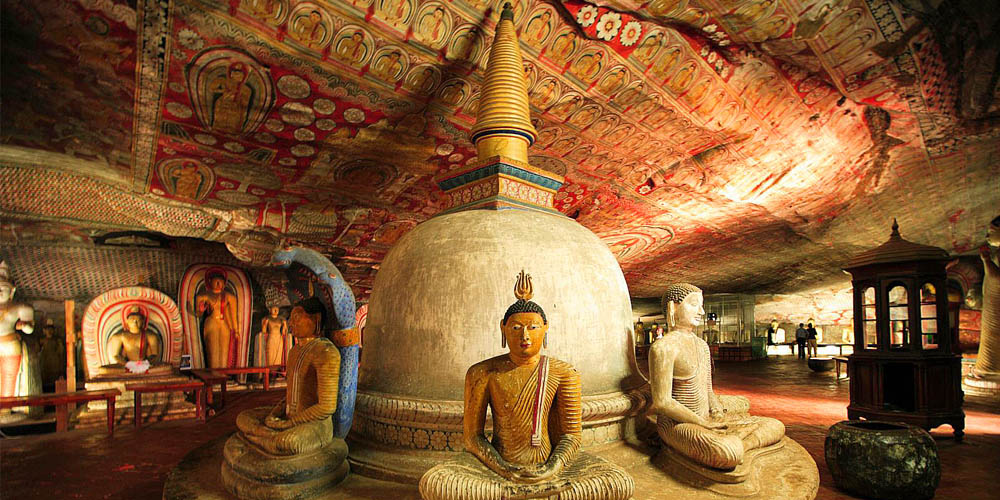
From the outside, the Dambulla Rock Temple barely announces itself. A long granite dome rises from the surrounding plain, and at its base, tucked under a vast natural overhang, five cave shrines open out of the stone. Inside, every ceiling and wall surface of those caves is covered in painting — 2,100 square metres of Buddhist murals, laid down and repainted over roughly two thousand years of continuous religious use.
The caves were first used as a monastic refuge in the 1st century BCE, when King Valagamba sheltered here during a period of exile from Anuradhapura. After returning to the throne, he converted the natural caves into royal shrines. Successive rulers added to them through the Polonnaruwa, Gampola and Kandyan periods, so what you see today is a palimpsest of overlapping patronage spanning nearly twenty centuries.
Cave II, the largest, holds 56 statues including a colossal reclining Buddha over fifteen metres long, its face turned gently sideways in the posture of final nirvana. The ceiling above it is entirely covered in repeated Buddha figures arranged in geometric grids — hundreds of them, painted in faded gold and ochre under the low rock vault. A natural spring drips through the ceiling of Cave I, considered sacred; its water has been catching in a stone vessel for centuries.
Dambulla was inscribed as a UNESCO World Heritage Site in 1991 and is one of the most visited sites in Sri Lanka. Go early morning before tour groups arrive. Remove shoes at the base of the final staircase. Look up as much as at the statues — the painted ceilings are where the real astonishment lives.