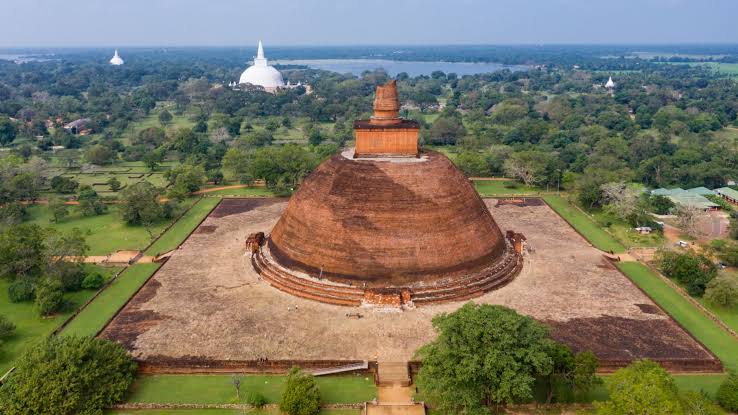
Standing in front of Jetavanaramaya is an odd experience because the sheer scale of it takes a moment to register. The stupa is not gleaming white like Ruwanwelisaya — it is raw, weathered brick, the colour of old terracotta, and it rises from the Anuradhapura scrub like a hill someone forgot to plant trees on. Only when you notice that the trees at its base are full-grown forest does the scale become clear.
Originally standing around 120 metres tall and covering more than two hectares at its base, Jetavanaramaya was built during the reign of King Mahasena in the 3rd century CE. Estimates of the brick count run to around 93 million. Governor Henry Ward, a 19th-century British colonial official, wrote that nowhere else in the world could one find so many ancient irrigation and monumental works of such scale packed into so small a space — and Jetavanaramaya is what he was looking at when he wrote it.
Modern archaeological investigation has revealed sophisticated internal engineering: the builders dug down to bedrock, laid compacted gravel foundations to spread the load, and varied the brick composition within the structure to distribute stress in ways that prevented the collapse that should theoretically have occurred under this much material. The thin-jointed brickwork using fine clay slurry behaves almost like a monolithic block, which is why so much of it still stands.
A small museum at the site houses finds from excavations including jewellery, gold sheet reliquaries and a gold plate inscribed with the name of the stupa — physical proof connecting the surviving monument to its chronicle records. Give it thirty minutes before walking the perimeter. The scale makes more sense once you know what you are looking at.