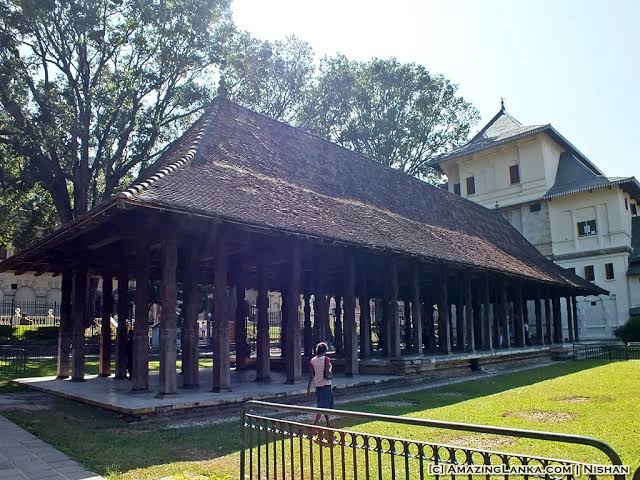
Most visitors to the Kandy royal palace complex spend their time in the Temple of the Tooth itself, walking straight past one of the finest pieces of wooden architecture in South Asia. The Magul Maduwa — the Royal Audience Hall — stands at the far end of the courtyard, an open colonnade of magnificently carved wooden pillars supporting a tiled roof, and it is free to enter.
The construction began under King Rajadhi Rajasinha in 1783 and was completed during the reign of the last king, Sri Vikrama Rajasinha, in 1807. Every pillar is carved from a single timber — ebony, satinwood, teak and other highland hardwoods — and each one is decorated with a different programme of carving: floral scrolls, animal figures, mythological creatures and geometric patterns worked into the wood with a precision that looks impossible given the tools available.
The hall was used for royal audiences, court ceremonies and the administration of justice. It was here that the Kandyan chiefs and British Governor Brownrigg assembled on 2 March 1815 to sign the Kandyan Convention, ending the last Sri Lankan monarchy. The room has absorbed that history without changing.
The Kandyan period produced extraordinary craft — lacquerwork, silversmithing, ivory carving, and above all woodcarving of a standard found nowhere else in the island — and the Audience Hall is its single finest surviving example. It is also, practically, a pleasant place to stand out of the heat. Take your time with the pillars. The carving rewards looking at for longer than feels natural.