After the catastrophic invasion of Magha of Kalinga in 1215 devastated Polonnaruwa, the Sinhalese court spent the next two centuries in a slow retreat southward and westward through a series of temporary capitals, each one on higher, more defensible ground than the last. Yapahuwa, a 90-metre granite rock in the North Western Province, served as the capital from around 1272 to 1293 CE and was the resting place of the Sacred Tooth Relic during that period.
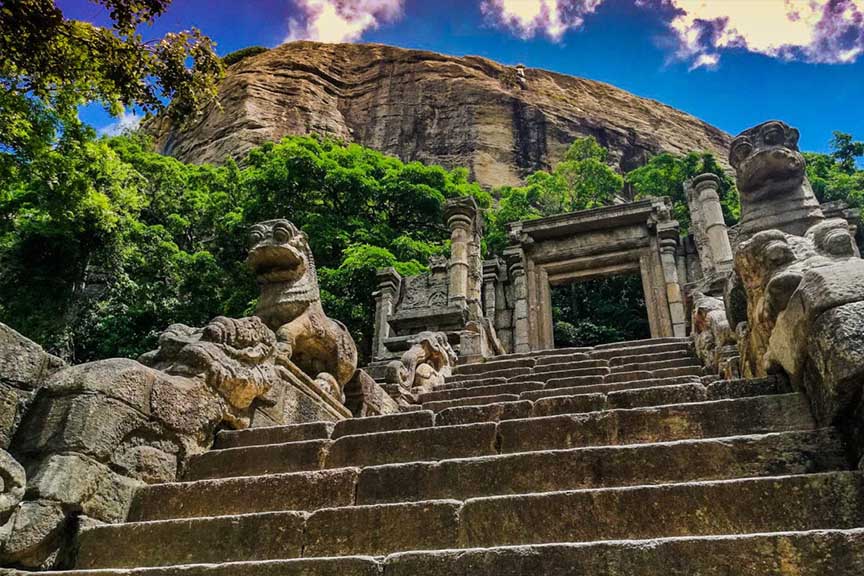
The capital is largely gone — timber structures, earthen ramparts and clay walls leave little for the archaeologist's spade. What survives, extraordinarily well, is the ornamental stairway that led to the upper royal precinct. It is a double staircase in pink granite, flanked by stone lions and makaras (mythological sea-creatures), with deeply carved panels of dancers, musicians and decorative work in a style that shows strong South Indian influence alongside the indigenous tradition. The gateway at the top, a carved stone portal, remains largely intact.
The stairway at Yapahuwa is often compared favourably to the more famous entrance at Sigiriya for the quality of its carving. It is less visited and sits in a quieter, more forested setting — the rock rising from flat jungle in a way that makes the climb feel genuinely like an ascent toward somewhere important.
The Sacred Tooth Relic was taken from Yapahuwa to South India by the Pandya ruler Arya Chakravarti in 1283, prompting King Parakramabahu III to negotiate and then sail personally to retrieve it — one of the more diplomatically fraught episodes in the relic's long and complicated history.