 History
Royal Palace of Hanguranketha
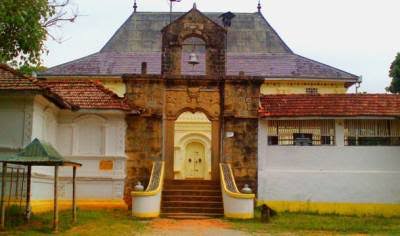
Hanguranketha has a long history .in this place was found an inscription by queen Leelawathi of the Polonnaruwa period and it was also a place that gave shelter to Konappu Bandara before his ascending the throne of kandy as king vimaladharmadsuriya 1.But the king who founded this city, according to Rajavaliya .was senerath.he built a palace here for temporary living. Later on Rajasingha 2 built a palace to suit a king. Robert Knox has given us a vivid description of this palace:
“He keeps his court at Digligy-neur (Diyatilaka Nuwara) whither he fled in a rebellion against him. His palace stands adjoining to a great hill….near unto that part of the hill next abutting upon his court none dares presume to set his foot for that being for his safeguard to fly unto in time of need .the palace is walled about with a clay wall and thatched, to prevent the clay being melted by the rains, which are great and violent. Within this wall it is all full of houses, most of which are low and thatched, but some are two stories high and tiled very handsomely, with open galleries for air , railed , about with tossed banisters, one ebony and one painted , but not much for pleasure as security . the palace it self hath many large and stately gates, two – leaved; these gates, with their posts, excellently carved ;the iron work thereunto belonging ,as bolts and locks, all rarely engrave. The Windows inlaid with Silver plates and ebony. On top of the houses of his palace and treasury stand earthen posts at each corner, which are for ornament; or which is a newer fashion, some thing made of earth resembling flowers and ….. And no houses beside, except temples, may have these placed with them. The contrivance of his palace is, as I may say, like Woodstock bower, with many turnings and windings and doors, he himself having ordered and contrived all these building and the manner of them. At all the and contrived all these buildings and the manner of them. at all the doors and passages stand watchers and they who thus give attendance are not to pass without special order from one place to another , but are to remain in that place , or at that gate where the king hath appointed them.
sometimes he walked about his palace, where there are certain pedestals of stone whitened with lime and laid in oil, so they look purely white, made and set up in divers places ; here he stands when he comes forth , that he might be above the rest of the people and see about him. But when he is minded to go abroad, though it be never so little away, and he seldom or never goes for all soldiers his guards which are a great many, it may be thousands, together with a Dutch or Portuguese captain …to stand at the gate in readiness to attend his pleasure … the stand at the gate in readiness to attend his pleasure …the palace where he Goethe when he comes thus abroad, is to a banqueting house built by a pond side, which he has made. It is not about a musket shot from his palace: where he Goethe for his diversion “.
This account by Knox of the palace and the king tells us of the grandeur that was at that time in Hanguranketha. King Narendrasinha held most of his time at Hanguranketha, during his short reign of eight years and came to be known as king of Hanguranketha. In 1803, when Kandy was abandoned on the approach of English troops, pilimatalawa and the king vacated the palace before their arrival, and retired to Hanguranketha.
This palace was destroyed in the rebellion of 1818, though some say it was destroyed in the 1803. However, even the foundation of the old palace is not traceable today. It is believed that the palace was situated in the place where you find a paddy field now called Vadana paya, just below the renovated tank.
The ruins of the old palace were utilized for the construction of the potgul Viharaya or temple library. Some of the ruins were removed to the Kandy museum. The present Viharaya was built by venerable Doratiyawe Attadassi soon after the rebellion .but for this no other vestiges of the old palace are seen today. The stone doorways, moonstones and Kandy hundreds of old lamp, stone pillars, and other objects can be seen there. The valuable collection of old manuscripts housed in this temple will help future researchers of kandyan history immensely. It is believed that the present Viharaya is built on the site where the old Rankot Viharaya stood. It is also believed that the potgul Viharaya was built by utilizing the ruins of the Devram Viharaya which is said to be the old Arattana Viharaya. However, these beliefs are confusing. This temple has a Buduge – a shrine room beautifully enriched with status of the four guardian gods, and with paiontings on the walls and ceiling. The Vessantara Jathakaya and the Suvisi Vivaranaya are two of these paintings behind the shrine room are a small painted Dagaba with the four surrounding walls similarly painted.
Copyed by C.C.F- Kandy –Anuradha senewiratna
Category: History
Articles exploring the ancient kingdoms, colonial era, and historical events that shaped Sri Lanka.
Related Articles
Independence Without a Single Shot: How Ceylon Became Sri Lanka
History
The Vedda: Sri Lanka's Indigenous Forest People
History

Ratnapura: The City of Gems
History