There are few places on earth where you can stand inside a city that functioned continuously as a capital for around 1,400 years. Anuradhapura is one of them. From roughly the 4th century BCE to the end of the 10th century CE, this sprawling settlement in Sri Lanka's dry northern plains was the political, religious and engineering centre of the island. Today it is a UNESCO World Heritage Site, inscribed in 1982, and one of the most rewarding places in Asia for a traveller who enjoys walking through history rather than reading about it.
A capital born from water
Anuradhapura sits in a landscape that receives generous rain for part of the year and almost none for the rest. A city of this size should not have been possible here. It existed because its rulers solved the water problem before they solved anything else. Three great reservoirs - Basawakkulama, Tissa Wewa and Nuwara Wewa - ring the ancient city, and the oldest of them is traditionally credited to King Pandukabhaya in the 4th century BCE.
These are not ornamental lakes. They are working infrastructure, still irrigating paddy fields more than two thousand years after they were dug. Walk the embankment of Tissa Wewa at dawn and you will see fishermen, egrets, and farmers going about business that has changed remarkably little in twenty centuries.
The arrival that changed everything
The single most consequential event in Anuradhapura's history took place on a hill about twelve kilometres to the east. In the 3rd century BCE, the monk Mahinda - son of the Indian emperor Ashoka - met King Devanampiya Tissa at Mihintale and introduced Buddhism to the island. The king converted, and with him the kingdom.
What followed was one of the great building programmes of the ancient world. Monasteries were endowed, relics enshrined, and enormous brick stupas raised across the plain. Buddhism did not merely arrive in Anuradhapura; it reorganised the city around itself.
Mountains made of brick
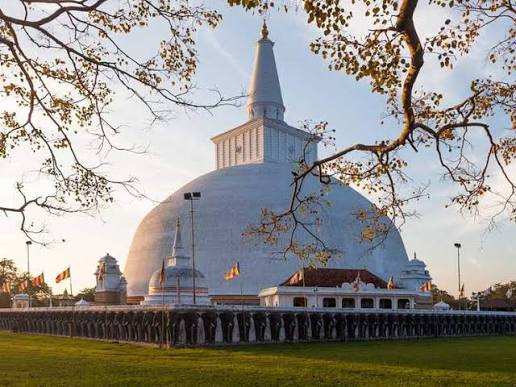
The stupas are the reason most visitors gasp. Ruwanwelisaya, begun by King Dutugemunu in the 2nd century BCE, is a dazzling white dome that remains an active place of worship - you will share the sand terrace around it with hundreds of white-clad pilgrims carrying lotus flowers.
Jetavanaramaya is a different experience entirely. Left in raw, weathered brick, it rises like a russet mountain from the scrub. When completed in the 3rd century CE, it was among the tallest structures on the planet, exceeded only by two of the Egyptian pyramids. The volume of brick involved has been estimated at over ninety million pieces. Abhayagiri, once the centre of a monastery that housed thousands of monks and welcomed Mahayana ideas alongside Theravada orthodoxy, completes the trio.
The oldest tree in the world with a written history
At the centre of it all stands the Jaya Sri Maha Bodhi, a sacred fig grown from a cutting of the tree in Bodh Gaya under which the Buddha attained enlightenment. It was planted in 288 BCE and has been tended, guarded and documented ever since. That makes it the oldest living tree planted by human hands with a continuous recorded history anywhere in the world. Gold-plated railings surround it, and prayer flags shiver in the heat.
Engineering beyond the monuments
Anuradhapura's sophistication went well past its religious architecture. The Kuttam Pokuna, or Twin Ponds, are a pair of beautifully cut granite bathing tanks fed by an underground conduit with settling chambers to filter silt - an eleventh-century plumbing system that would not embarrass a modern engineer. The city had hospitals, refectories that fed thousands of monks daily, stone-lined drains, and quarters laid out with an eye to caste, craft and function.
Ancient visitors noticed. The Chinese pilgrim Fa-Hien, who stayed on the island in the early 5th century CE, recorded a city of monasteries, processions and enormous alms-giving. Roman coins have surfaced in Sri Lankan soil. This was a node on the maritime trade routes linking the Mediterranean to China, not an isolated backwater.
Decline and rediscovery
Repeated invasions from South India put pressure on the capital, and in 993 CE the Chola empire captured Anuradhapura. The centre of power shifted southeast to Polonnaruwa, and the old city was gradually abandoned to the forest. For centuries it was known to villagers and pilgrims but largely swallowed by jungle.
British colonial officers and archaeologists began clearing and surveying it in the 19th century, and systematic conservation has continued ever since. What you see now is a working compromise: some monuments restored and actively worshipped, others left as evocative ruins.
Visiting Anuradhapura
The site is enormous - roughly forty square kilometres - so a bicycle or a hired vehicle is essential. Start early; the dry-zone sun is unforgiving by ten o'clock. Sacred areas require shoulders and knees to be covered, and shoes must be removed before entering stupa terraces, where the sand can get genuinely hot.
Give it a full day at minimum, two if you can. And try to be at Ruwanwelisaya as the light goes gold in the late afternoon, when the crowds thin and the drumming starts. It is a moment that explains, better than any guidebook, why this city mattered for a thousand years.