If Anuradhapura is sprawling and ancient, Polonnaruwa is compact and comprehensible. That difference makes it the favourite of many travellers. You can cycle the whole archaeological park in a morning, and because it flourished for a shorter, more concentrated period, the city has an architectural coherence that its predecessor lacks. It was inscribed as a UNESCO World Heritage Site in 1982.
How a garrison town became a capital
Polonnaruwa began as a strategic outpost. It sat closer to the Mahaweli river crossings and was easier to defend against invasions from the north than Anuradhapura had been. When the Chola empire of South India captured Anuradhapura in 993 CE, they made Polonnaruwa their administrative base and ruled from there for some seventy-five years.
In 1070 CE, King Vijayabahu I drove the Cholas out and chose to keep the capital where it was. That decision set the stage for the island's medieval golden age.
Parakramabahu the Great
The reign of Parakramabahu I, from 1153 to 1186 CE, is the period everything at Polonnaruwa points towards. He unified the island under a single ruler, launched military expeditions overseas, reformed the Buddhist monastic order, and built on a scale that still seems implausible.
The chronicle known as the Culavamsa credits him with building or restoring 163 major reservoirs, 2,617 minor tanks, 3,910 irrigation channels and 328 stone sluices, along with repairing nearly two thousand breaches in embankments. His most famous statement has become a national motto of sorts: that not even a drop of rainwater should reach the sea without first serving humanity.
His greatest work is visible the moment you arrive. The Parakrama Samudra, the Sea of Parakrama, covers around thirty square kilometres behind an embankment fourteen kilometres long. It irrigated close to a hundred square kilometres of farmland. Standing on its bund at sunset, watching fishermen pole home across water that looks oceanic, it is difficult to remember you are inland.
The buildings
The royal palace of Parakramabahu was reportedly seven storeys high. Three storeys of brick wall survive, riddled with the sockets that once held massive timber beams, and even the ruin conveys the ambition. Nearby, the Council Chamber retains a carved stone plinth with processions of elephants, each one individually posed.
The Quadrangle, or Dalada Maluwa, is the compact sacred precinct at the city's heart and the single richest concentration of monuments in Sri Lanka. Within a few dozen paces you will find:
- The Vatadage - a circular relic house with concentric stone columns, four Buddha images facing the cardinal points, and what many consider the most refined moonstone carving on the island.
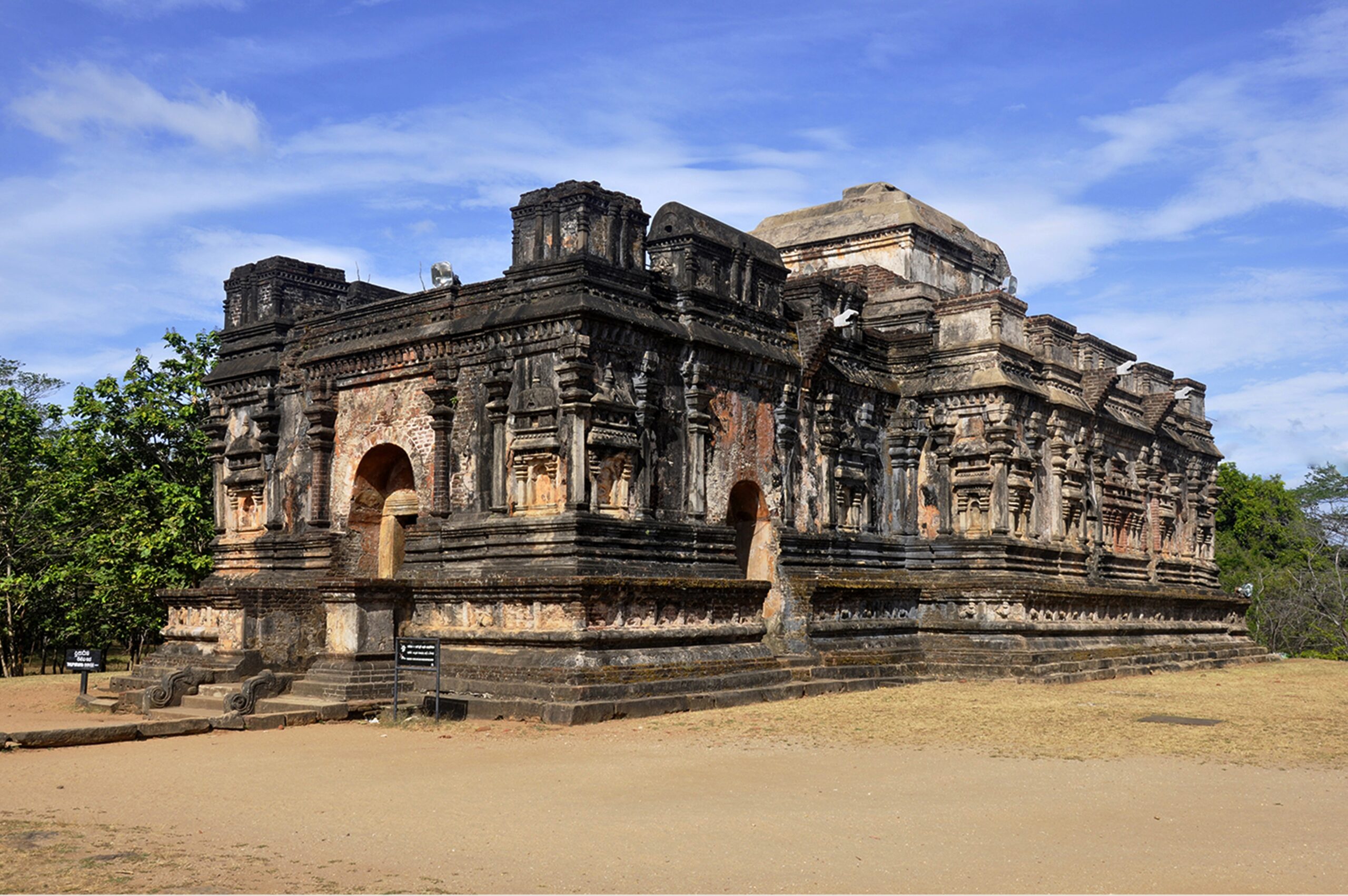
- Thuparama - a brick image house with a vaulted roof still intact, unusual because so few roofed structures of this age survive.
- The Gal Pota - the Stone Book, a granite slab over nine metres long inscribed with the achievements of King Nissanka Malla. It was hauled from Mihintale, roughly a hundred kilometres away.
- Satmahal Prasada - a stepped, pyramid-like tower whose form is unlike anything else in Sri Lanka and suggests Southeast Asian influence.
Gal Vihara
A short ride north brings you to the reason many people come. Gal Vihara is a single granite outcrop from which four Buddha images have been carved: a seated figure in meditation, a smaller seated image inside a rock cavity, a standing figure with arms crossed at the chest, and a reclining Buddha just over fourteen metres long depicting the passing into final nirvana.
The carving is extraordinary. The sculptors worked with the grain of the rock, using a natural vein of darker stone to run diagonally across the reclining figure. The subtle sag of the pillow under the head, the slight lift of the upper foot behind the lower one - these are details that reward standing still for a while. It is widely regarded as the summit of Sri Lankan stone sculpture.
Lankatilaka and the Rankot Vihara
Lankatilaka is a roofless brick image house with walls seventeen metres high funnelling towards a headless standing Buddha. The scale is deliberately overwhelming, and the effect of walking down that brick corridor towards the figure is one of the most theatrical experiences in Sri Lankan architecture. Rankot Vihara, meanwhile, is the largest stupa at Polonnaruwa and the fourth largest on the island.
Why it ended
Polonnaruwa's brilliance was brief. Parakramabahu's building programme drained the treasury, succession disputes followed, and a devastating invasion led by Magha of Kalinga in 1215 shattered the kingdom. Within decades the capital moved again, this time southwest, beginning a long retreat of Sinhalese power towards the wet zone and eventually to Kandy.
Malaria and the collapse of irrigation maintenance finished the job. The city was reclaimed by forest until archaeological work resumed in the colonial period.
Practical notes
Rent a bicycle - the site is flat, shaded in stretches, and far more enjoyable on two wheels than in a vehicle. Allow four to five hours. Bring socks: you will be removing your shoes repeatedly at sacred sites and the stone gets scorching. The archaeological museum near the entrance is genuinely good and worth thirty minutes before you set out.