Visitors to Sri Lanka tend to remember the stupas and the frescoes. But historians of technology reserve their real astonishment for something less photogenic: the tanks. The island's dry zone is stitched with tens of thousands of reservoirs, some of them well over two thousand years old, many of them still in daily use. A 19th-century British governor of Ceylon, Sir Henry Ward, observed that nowhere else in the world could one find so many irrigation works of such antiquity and such magnitude packed into so small a space.
The problem
Sri Lanka's northern and eastern plains - the historic Rajarata, or King's Country - receive most of their rain in a concentrated monsoon season and then endure months of drought. Rivers run hard and then run dry. To grow rice, the staple that underwrote the whole civilisation, you need reliable water in the dry months.
The solution was to catch the monsoon and hold it. The Sinhala word for these reservoirs is wewa, usually translated as tank, and the earliest one that can be confidently identified is Basawakkulama at Anuradhapura, attributed to King Pandukabhaya, who reigned in the 4th century BCE.
The invention that made everything else possible
Building a small pond is easy. Building a reservoir several kilometres across is a different problem, because water at depth exerts enormous pressure. Open a sluice at the base of a large dam without controlling that pressure and the escaping jet will scour out the conduit, undermine the embankment and destroy the whole structure.
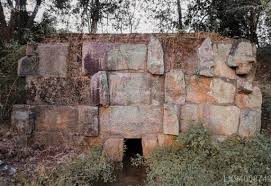
Sri Lankan engineers solved this with the bisokotuwa - a valve pit or valve tower built into the embankment, generally credited to around the 3rd century BCE. Water from the reservoir enters a large vertical chamber of precisely dressed granite blocks. Inside that chamber, the pressure dissipates and the turbulence settles. Water then leaves through a controlled outlet at a manageable velocity.
The principle is essentially that of a modern valve pit, arrived at roughly two millennia earlier. The engineer H. Parker, writing in 1909, argued that without this single invention the Sinhalese could never have progressed beyond minor tanks. Some bisokotuwa were even used to turn the direction of flow: at an outlet of the Parakrama Samudra, water enters on one side and leaves at right angles, the force needed for the turn supplied by the water itself, so nothing erodes.
The anatomy of a tank
A traditional wewa is a designed system, not just a hole holding water. Its parts have names and jobs:
- Sorowwa - the sluice gate. Large tanks have two: a goda sorowwa releasing water to the fields, and a mada sorowwa lower down to flush accumulated silt.
- Pitawana - the spillway that safely discharges excess water during heavy rain.
- Diyakata pahana - a stone water-level gauge, allowing operators to judge how generously to release.
- Diya mankada - a designated zone for drawing drinking water, kept apart from areas used for bathing, laundry and livestock.
Smaller village tanks used a simpler log sluice: cylindrical timbers stacked one above another, removed one at a time to lower the outlet level and drain the tank completely when required.
The cascade system
The genius was not only in individual tanks but in how they were linked. Village tanks were arranged in cascades along a small valley, so that overflow and seepage from an upper tank fed the next one down, and the next after that. Nothing was wasted. Surrounding each tank was a set of protective zones - a tree belt to reduce evaporation and windborne silt, a reed bed to filter runoff, an upstream meadow to trap sediment.
This is why the phrase "cascade system" now appears in international sustainable agriculture literature. The ancient Sri Lankan village tank cascade is studied today as a model for water-scarce regions facing climate stress.
The great tanks
The largest works came from the pens of ambitious kings. Kala Wewa, built by King Dhatusena in the 5th century CE, fed Anuradhapura through the Yoda Ela - a canal running some eighty kilometres with a recorded gradient of only around ten centimetres per kilometre in places. Surveying a slope that shallow, without modern instruments, over that distance, remains one of the more remarkable feats in the history of engineering.
Minneriya, Kaudulla, Giritale and Kantale are others still in service. And the largest of all, Parakrama Samudra at Polonnaruwa, was one component of a programme in which King Parakramabahu I is credited with building or restoring more than 160 major reservoirs and over 2,600 minor ones.
Collapse and revival
When the medieval kingdoms fell apart after the 13th century, the maintenance regime collapsed with them. Embankments breached, channels silted, malaria spread in the stagnant remnants, and populations drifted to the wet southwest. Much of Rajarata reverted to forest.
British colonial engineers began restoring selected tanks in the 19th century, and independent Sri Lanka has continued the work, most dramatically through the Mahaweli Development Programme of the late 20th century. Many of the tanks irrigating fields today sit on foundations laid before the Roman Empire existed.
Seeing it for yourself
You do not need to be an engineer to appreciate this. Stand on the bund of Parakrama Samudra at dusk, or watch elephants gather at Minneriya as the water recedes in the dry season and fresh grass appears on the lakebed. The Sri Lankan landscape you are looking at is not natural. It was designed, and it has been running for two thousand years.